Own an AI trading network harvesting profits from prop firms.
Not one account. A network of them. Our proven AI trading software runs across a portfolio of funded futures accounts, we handle the setup and integration, and the payouts come to you. Your own capital never goes into the market.




running the software
traded on the program
across the account base
Most people trying to build a second income stream are quietly betting their savings to do it.
The usual path to meaningful cashflow is to put more of your own money into the market and hope the return justifies the exposure. That is slow, it is stressful, and it puts capital you already earned at risk to chase capital you have not.
The Funded Futures Program removes that trade-off. Proprietary trading firms will put their capital behind a system that can prove an edge, and they will do it across many accounts at once. Algo Alpha built the part that proves the edge: futures software that passes the evaluations and trades the funded accounts automatically, with defined risk on every position.
You supply the license and the account fees. The firm supplies the trading capital. The profit is split, and your share is paid out to you as cashflow. Your money buys access to buying power. It does not go into the market.
$60,500 on a single $100,000 account. Twelve months. Automated, start to finish.
One account. One year of live-tracked, deeply back-verified execution on the same engine we deploy for the program. This is what a single seat looks like before you multiply it.
Figures reflect a single $100,000 futures evaluation account running the Algo Alpha futures engine over the trailing 365-day period, measured in USD. Chart is a visual representation of the cumulative P&L curve for that period. Results shown are historical and specific to this account, its start date, and its market conditions. Past performance is not indicative of future results.
The documentation behind it.
Read it yourself. Below is the full portfolio analysis for the Funded Futures Algo, the NQ (E-mini Nasdaq-100) futures program traded through Tradovate under prop-firm risk parameters. Every figure in it is computed from read-only broker and trade records, with deposits and withdrawals excluded so funding activity is never counted as performance.
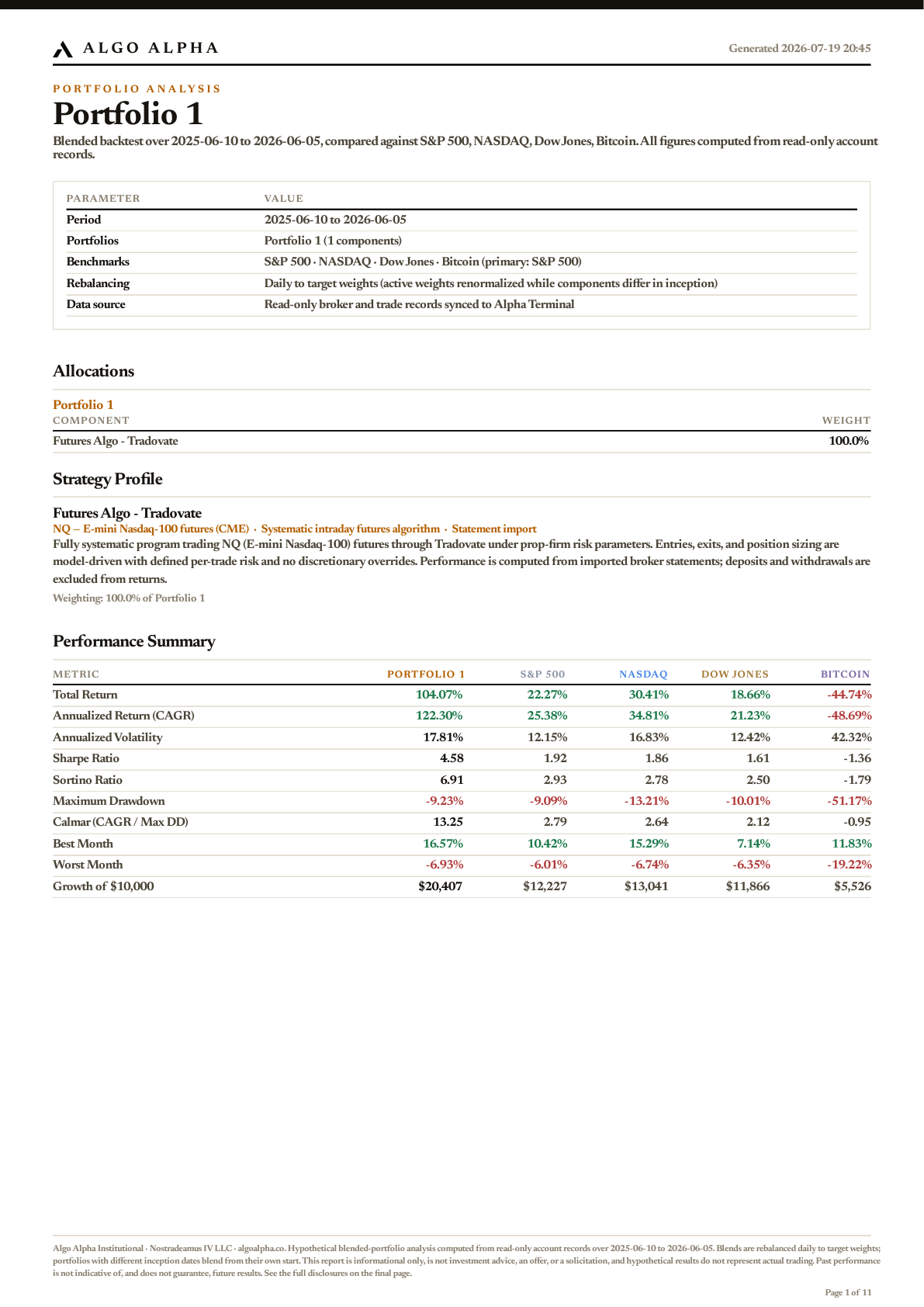 Page 1 · Performance summary vs four benchmarks
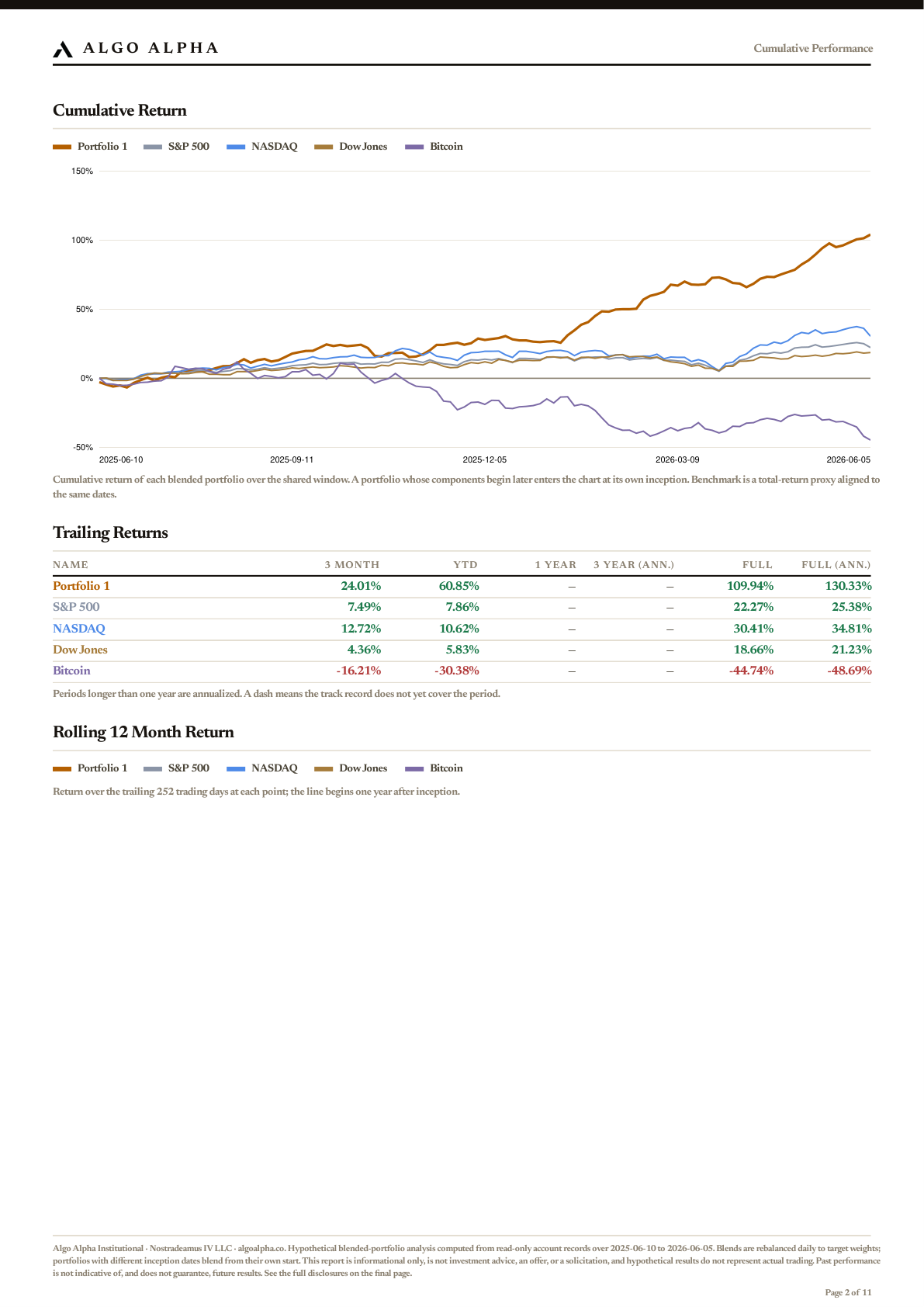 Page 2 · Cumulative performance
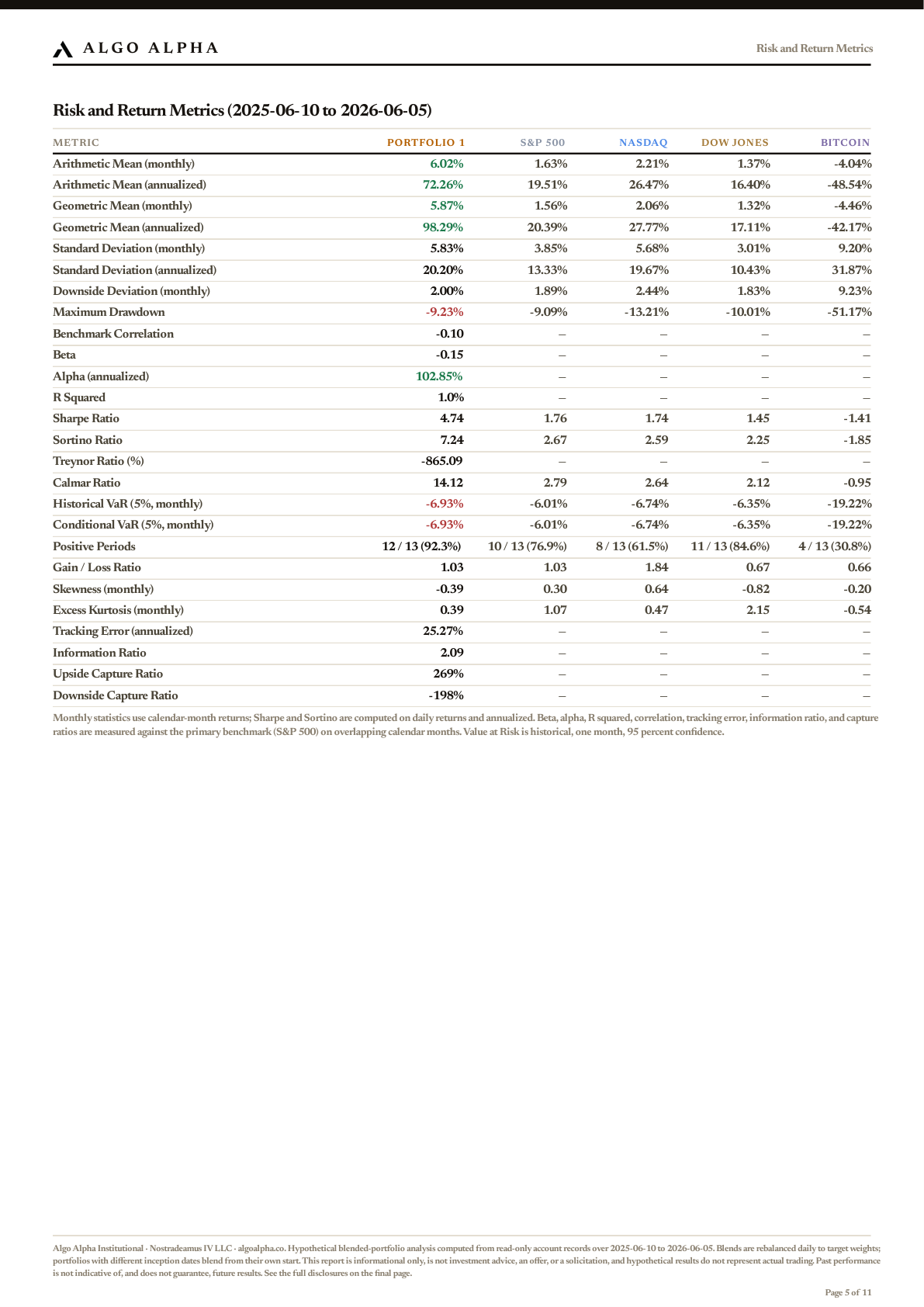 Page 5 · Risk & return metrics
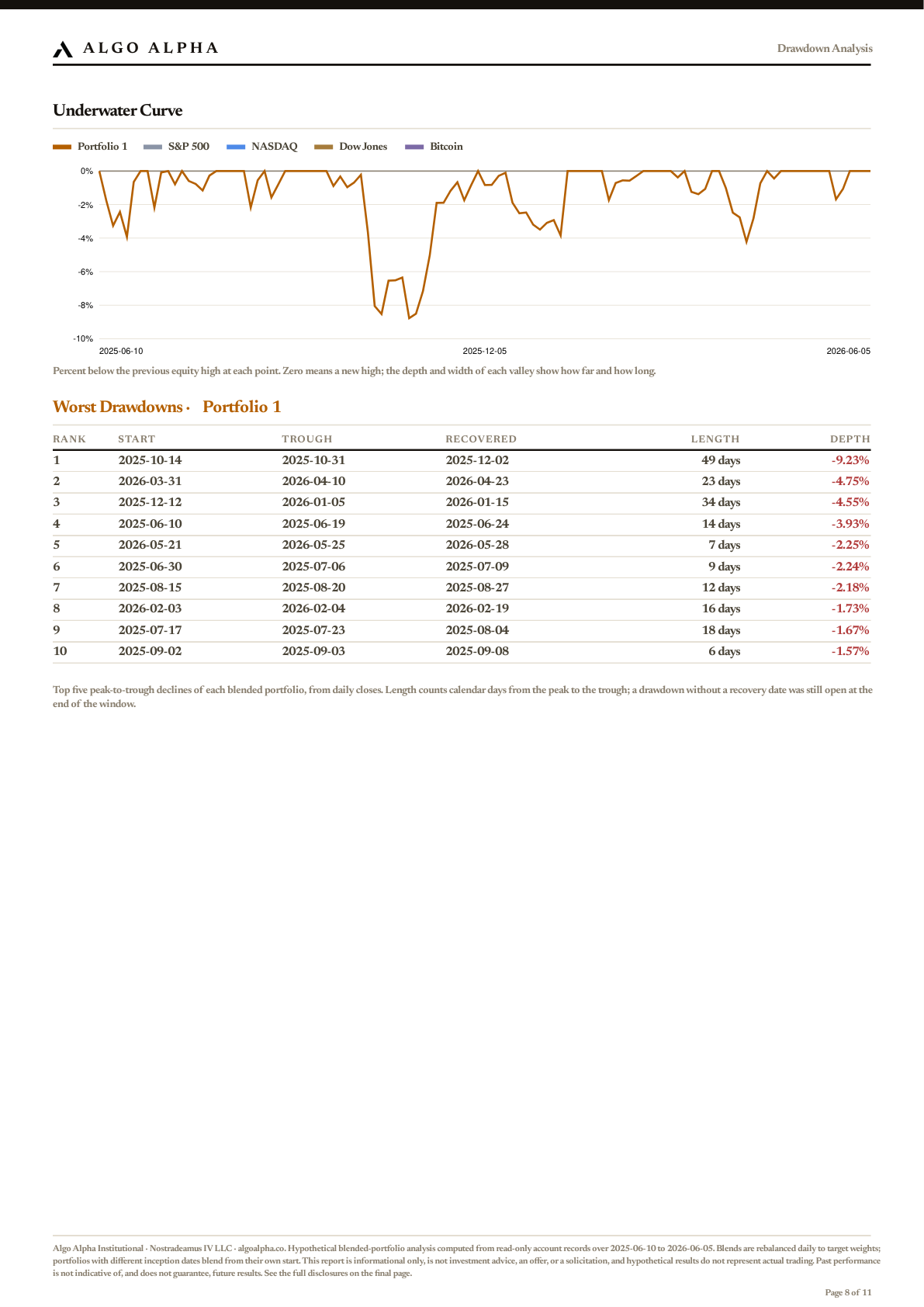 Page 8 · Drawdown analysis
How the Funded Futures Algo compares.
Straight from page 1 of that document. Same window for every column, 2025-06-10 to 2026-06-05.
| Vehicle | Total return | Max drawdown | Sharpe | Growth of $100,000 |
|---|---|---|---|---|
| Funded Futures Algo · Algo Alpha | +104.07% | -9.23% | 4.58 | $204,070 |
| S&P 500 | +22.27% | -9.09% | 1.92 | $122,270 |
| NASDAQ | +30.41% | -13.21% | 1.86 | $130,410 |
| Dow Jones | +18.66% | -10.01% | 1.61 | $118,660 |
| Bitcoin | -44.74% | -51.17% | -1.36 | $55,260 |
Source: Algo Alpha portfolio analysis, generated 2026-07-19, covering 2025-06-10 to 2026-06-05. The Funded Futures Algo appears in that report as “Portfolio 1” and is a single component, the NQ futures algorithm traded via Tradovate, computed from read-only account records with deposits and withdrawals excluded. Benchmarks are total-return proxies aligned to the same dates. The growth column restates that report's growth-of-$10,000 figures on a $100,000 basis; because growth compounds the same underlying return series, the scaling is arithmetic and adds no new performance claim. That report states its blended-portfolio figures are hypothetical and do not represent actual trading. You cannot invest directly in an index, and a leveraged futures program is not a like-for-like risk comparison to a long-only index. Past performance is not indicative of future results.
These are two separate records, not one. The $60,500 figure above is a single $100,000 futures account measured over a trailing 365-day window. The 104.07% here is the Funded Futures Algo analysis over 2025-06-10 to 2026-06-05. Different windows, different measurement, and they are presented separately on purpose rather than blended into one headline.
Note the second number as much as the first. A 4.15% max drawdown on a 60.50% return is the whole point in a prop context: the accounts have hard drawdown limits, and the engine is built to respect them. Returns are what earn the payout. Drawdown control is what keeps the account alive long enough to collect it.
Four steps. Then it runs without you.
You are never asked to trade, monitor a chart, or make a call. Your involvement is front-loaded into setup, and then the program is hands free.
Get started and license the technology
You pay for the service and the software technology license. We confirm which package you qualify for and how many funded accounts you are eligible to run on it.
We set up and integrate the accounts
We walk you through opening your prop firm evaluation accounts and handle the technical integration end to end. Account setup runs roughly $100 to $200 per account.
The software passes the evaluations
Once connected, the engine trades the evaluation to its profit target inside the firm's drawdown rules. No manual intervention, no judgment calls, no discretion.
Funded accounts trade, you take payouts
Funded accounts trade automatically on your behalf. You request payouts on the firm's schedule and keep your share of the split, which is set by your package tier.
Throughout, you get the reporting. Live dashboards, account-by-account performance, trade history, and payout tracking. You always know exactly what every seat is doing.
One engine. Three, five, or ten accounts running it in parallel.
This is where the model compounds. The same signal that produced the case study above does not get better when you add accounts. It gets wider. Each additional funded seat is another independent claim on the same edge, and each one carries its own payout.
Core
- Full technology license and integration
- Managed evaluation setup on all 3 accounts
- Live reporting dashboard access
- Base profit split
Scale
- Everything in Core
- Managed evaluation setup on all 5 accounts
- Improved profit split versus Core
- Priority replacement on failed evaluations
Portfolio
- Everything in Scale
- Managed evaluation setup on all 10 accounts
- Top profit split in the program
- Direct line to the deployment team
Futures markets
ES, NQ, CL, GC and YM. Price, volatility, liquidity and cross-asset flow streamed continuously.
The Algo Alpha engine
Signal generation with defined risk per trade, drawdown guardrails tuned to prop-firm limits, executing 24/5 without discretion.
Your funded accounts
The same signal fires into every seat you run in parallel, whether that is 3, 5 or 10 funded accounts.
Your split, your bank
Each funded account pays out on its firm's schedule. Your share of the split is paid to you.
Three things have to be true. All three are, and they are independently verifiable.
The system is proven
A 2.091 profit factor across 291 trades with a 70.45% win rate is not a lucky streak. It is a distribution. The engine is deterministic, so every account running it is trading the same tested logic, not a discretionary opinion.
The risk fits the constraint
Prop firms fail traders on drawdown, not on returns. A 4.15% peak drawdown sits well inside the limits these firms enforce. The engine was tuned to the constraint, which is why it survives the evaluation instead of blowing through it.
The capital is not yours
Because the firm funds the account, your downside is capped at the license and the account fees. Your upside scales with the number of seats. That asymmetry is the entire reason this model exists.
Where your money actually goes.
In a traditional account, effectively all of your capital sits in the market and carries market risk. On this program, your outlay is a license and a set of account fees, and the trading capital is the firm's. Same engine. Very different exposure.
Investors and professionals who want the cashflow without the second job.
Two groups do well here. Investors who already have capital working elsewhere and want an additional, uncorrelated stream that does not require moving money into the market. And professionals with strong income and no time, who want their money compounding through something that runs without them during the workday.
What both have in common: they want take-home profit, not a hobby. After setup there is no chart to watch, no decision to make, and nothing that competes with the career or the portfolio you already have.
At least $20,000 in capital
The program requires a minimum of $20,000 in available capital to license the technology and fund the account setup across your tier.
Willingness to run multiple accounts
The math works on breadth. Three accounts is the floor, and the model gets meaningfully better at five and ten.
A hands-off temperament
After setup, you do not trade, override, or intervene. If you want to make calls yourself, this is the wrong program.
A realistic time horizon
Average return on the program outlay has been landing in the 2.5 to 3 month range. Come in expecting a quarter, not a week.
What can go wrong, stated plainly.
Because you are not putting trading capital into the market, your capital-at-risk is limited to what you pay for the license and the account fees. That is the structural advantage, and it is real.
The risk that remains is account risk. From time to time a prop account will fail its evaluation or breach a drawdown limit and be closed by the firm. That is a normal, expected part of the model, which is exactly why the program is built around running many accounts rather than one. At roughly $100 to $200 per account setup, replacing a lost seat is inexpensive relative to what a surviving seat produces. The strategy is to farm as many accounts as possible so no single failure matters.
None of this is a guarantee of profit. Futures trading carries substantial risk of loss, evaluation outcomes vary, and payouts are always subject to the individual prop firm's own rules and terms.
The things everyone asks before they book.
Q1How does this program actually work?+
It is deliberately simple. You get started by paying for our services and the software technology license. From there we walk you through the number of accounts you are eligible to set up under your package.
Once the software is connected to those accounts, it does the rest: it passes the evaluations, conducts the trades, and you keep the payouts. Depending on which package you are on, there is a different profit split in your favor.
Q2How long does it take to get set up and see money?+
- Live in as little as 3 days from the moment you get started.
- Roughly 2 weeks on average to pass an evaluation and convert an account to funded.
- First payout within the first 45 days is the typical experience.
These are averages drawn from accounts already on the program, not promises. Individual accounts move faster or slower depending on market conditions during the evaluation window.
Q3What is the risk?+
Risk is structurally minimized because you are not putting your own capital into the market. Your exposure is the license and the account fees.
What can happen is that a prop account fails its evaluation or gets closed for breaching a drawdown limit. That is expected and normal. The standard approach is to farm as many accounts as we can, so that the outcome of any one account does not determine your result. New account setup runs about $100 to $200 per account, so the cost of replacing a seat is minimal while the upside on a surviving seat is high.
Q4What does the software trade?+
Futures. The engine trades liquid futures contracts, which is what the major proprietary trading firms fund and what their evaluation rules are written around.
Q5How many accounts can I run?+
There are three packages, at 3, 5, and 10 funded accounts. Your package determines both how many seats you run and what profit split you receive, with the larger packages carrying the better split.
We have over 100 accounts live on this technology today, with over $3.5 million in firm capital being actively traded and over $250,000 per month being generated across that base.
Q6What is the $60,500 case study?+
It is a single $100,000 prop firm account, running the futures engine for one year. Over that period it produced +$60,500, a 60.50% return, with a maximum drawdown of 4.15%, a 70.45% win rate across 291 trades, and a profit factor of 2.091.
That is one seat. The packages exist so you can run that same engine across three, five, or ten seats at once. Past performance is not indicative of future results.
Q7What do I need to qualify?+
A minimum of $20,000 in capital to license the technology and set up your accounts. Beyond that, the consult is about matching you to the right package. Average return on the program outlay has been landing within 2.5 to 3 months depending on the package you select.
Q8How much of my time does this take?+
Effectively none after setup. Once the prop accounts are opened and the integration is complete, the experience is fully hands free. We manage the technology integration. The software trades. You watch the reporting and take payouts.
Q9Do I get visibility into what is happening?+
Yes. You get access to the reporting and dashboards covering every account you run: live performance, trade history, evaluation status, and payout tracking, account by account. You should never have to wonder what a seat is doing.
Q10What happens on the consult?+
It is a short, direct conversation to establish whether this is a fit in both directions. We walk you through the technology and the live numbers, review your capital and objectives, and identify which package makes sense. If it is not a fit, we will tell you on the call.
What it is like to actually work with us. In our clients' words.
Every review below is a real, verified Trustpilot review from an Algo Alpha client, reproduced word for word.
Clear for beginners, solid for pros
Whether you're brand new to automated trading, naturally cautious with your capital, or experienced enough to be skeptical, the onboarding process immediately puts you at ease. Everything is clearly laid out, step by step, with an emphasis on doing things correctly rather than rushing people through.
Onboarding was a smooth experience
Onboarding was a smooth experience, it's easy to follow instructions make it simple enough for the inexperienced trader like myself. Robert was quick to respond and kept me informed with his newsletter. Overall great experience. Now I'm just interested in seeing the growth.
Onboarding was super easy and smooth
Onboarding was super easy and smooth. Especially since I was already using both broker options. Robert was great to work with. Excited to see how well Alpha Gold performs!
Very easy to setup and connect
The Algo Alpha X and Algo Alpha Gold were very easy to setup and connect to my broker. I am recommending this Algorithm trading to anyone that is interested in trading or growing their financial portfolio.
The communication is amazing
The communication is amazing. They keep you in the loop, with great communication on next steps.
Great service with excellent care
Great service with excellent leadership! Very attentive and helped throughout the process to the finish!
Reviews are verified Trustpilot reviews left by Algo Alpha clients about their experience with the firm and its programs generally; they are not testimonials for the Funded Futures Program specifically and do not describe results from it. Individual experiences vary. No reviewer was compensated for their review. Past performance and any individual client experience are not indicative of future results.
Will you be next?
Book a time with our team to see if the program is a fit and which package matches your capital.
See the engine, the live account base, and the verified numbers behind the case study.
We size you to 3, 5, or 10 accounts based on your capital and objectives.
Exactly what setup, evaluation, and first payout look like on your specific start date.